Zero Trust Foundations: Cross Functions – Visibility, Automation, and Governance
How Visibility and Analytics, Automation and Orchestration, and Governance turn the Five Pillars into a functional Zero Trust Architecture you can operate, measure, and improve.
Summary: The Five Pillars help us make better trust decisions, but the cross functions help us prove those decisions are happening, implement controls consistently, and keep implied trust from creeping back in. This week, we focus on Visibility and Analytics, Automation and Orchestration, and Governance as practical operating functions for a functional Zero Trust Architecture, not a finished, fully automated, self-healing ecosystem.

Grab a fresh cup of coffee and let’s pick up where we left off. Last time, we talked about the Five Pillars: Identity, Device, Network, Application, and Data. Those pillars give us the inputs for better trust decisions. They help us ask who is acting, what they are using, where the transaction is going, what action is being attempted, and what data or business value is at stake.
But pillars alone do not make Zero Trust work. A diagram with five pillars can still become shelfware if nobody can see whether the controls are working, if changes are still made by hand in inconsistent ways, or if governance only shows up once a year with a spreadsheet and a sad meeting invitation.
That is where the cross functions come in. Visibility and Analytics, Automation and Orchestration, and Governance are the operating muscles around the pillars. They do not replace the pillars. They keep the pillars honest. They help us prove that trust decisions are being enforced, implement controls consistently, and catch the early signs that policy drift is trying to bring implied trust back into the room.
Before we go further, let me set the expectation clearly. In this series, we are focused on building a functional Zero Trust Architecture. We are not pretending that the first version will be a finished, fully automated, fully adaptive ecosystem that senses every risk and responds perfectly on its own. That may be the long-term destination for some organizations. It is not where most teams begin. The first goal is more practical: make better decisions, prove they happened, implement them consistently, and improve them without losing control.
Visibility and Analytics: Decision-Grade Telemetry
Let’s start with visibility, because Zero Trust without visibility is mostly a wish. If we cannot see the transaction, we cannot validate it. If we cannot validate it, we cannot prove the trust decision was enforced. And if we cannot prove it, we are back to hoping the controls worked instead of knowing they did.
For a functional Zero Trust Architecture, I like to use the phrase decision-grade telemetry. That means the logging and telemetry are complete enough to recreate any meaningful action using the telemetry alone. Not every packet forever. Not noise for the sake of noise. Decision-grade telemetry means we can answer the important questions after the fact without relying on memory, screenshots, or someone saying, “I think that is how it worked.”
If a user downloaded sensitive records, changed a payment destination, approved a workflow, accessed a privileged console, connected through a vendor support path, or caused a service account to move data, the telemetry should let us recreate the story. Who or what acted? What device, workload, or session was involved? What application or interface was used? What data was touched? What policy was evaluated? What decision was made? What control enforced that decision? What changed as a result?
That is the standard. The quality of the data needs to be good enough to prove that the trust decision being enforced by the pillars was done, every time. If Identity says the user was challenged, Device says posture was checked, Network says the path was limited, Application says the action was allowed, and Data says sensitivity was considered, then the telemetry should support that story. If it cannot, we do not yet have enough visibility to trust the architecture.
Analytics then turns that visibility into useful insight. We are looking for patterns that tell us whether trust is shrinking or growing, whether controls are working or being bypassed, whether exceptions are becoming normal, and whether a protect surface is drifting away from the policy statement we wrote for it.
· Can we reconstruct the transaction? For high-value actions, telemetry should show the actor, device or workload, application, data, policy decision, enforcement point, and result.
· Can we prove enforcement? Logs should show not only that a policy exists, but that it was evaluated and applied to the transaction.
· Can we spot drift? Analytics should reveal stale exceptions, risky access patterns, unexpected data movement, unmanaged devices, or control gaps before they become normal.
· Can we explain outcomes? The data should support investigation, audit, troubleshooting, and continuous improvement without needing a scavenger hunt across disconnected systems.
Automation and Orchestration: Consistency Before Autonomy
Automation is where a lot of Zero Trust conversations get ahead of themselves. People jump straight to the vision of systems responding on our behalf: automatically isolating devices, revoking sessions, changing access, opening tickets, updating policies, and blocking activity without a human in the loop. That future may be appropriate for some well-tested scenarios, but it should not be the first promise we make.
In the early stages of a functional Zero Trust Architecture, automation should focus primarily on implementing controls consistently. We want fewer hand-built firewall changes, fewer manually assigned permissions, fewer console-by-console configuration updates, fewer “just this once” exceptions, and fewer changes that depend on who happened to be on call that day.
This is the time to begin moving most hands-on activities toward programmatic implementation. That may mean access policies defined as code, infrastructure changes deployed through approved pipelines, configuration baselines enforced through management platforms, identity groups managed through lifecycle rules, and security controls tested before they reach production. The point is not to remove people from accountability. The point is to remove inconsistency from implementation.
The SDLC pipeline is a natural place to start. If an application is being changed, then the trust controls around that application should move through a repeatable process too. Access rules, logging requirements, secrets handling, service identities, network paths, data handling controls, and policy checks should not be bolted on later by hand. They should be part of the same disciplined path that moves code from idea to production.
Infrastructure belongs in that conversation too. A functional Zero Trust Architecture depends on consistent infrastructure, not lovingly hand-crafted snowflakes that only one person knows how to rebuild. Image factories, golden image pipelines, infrastructure-as-code templates, configuration baselines, container build processes, and policy-as-code checks all help make servers, workstations, cloud resources, and workloads more predictable. If every new system starts from a known, tested, patched, logged, and monitored baseline, then the Device, Network, Application, and Data pillars have better signals to work with from the beginning.
Think of an image factory as a coffee roaster for infrastructure. We do not want every cup brewed from mystery beans, at a random temperature, in a different pot. We want a repeatable process that starts with approved ingredients, applies the same security controls, records what went into the build, tests the result, and only then lets that image become part of the environment. That does not make infrastructure perfect, but it does make it easier to trust, verify, patch, replace, and retire.
This is also the right time to begin automating the creation of Software Bills of Materials, or SBOMs. An SBOM gives us a machine-readable inventory of the software components and dependencies that make up an application or workload. For Zero Trust, that matters because the application pillar cannot make strong trust decisions if we do not understand what the application is built from, where those components came from, and whether known vulnerabilities or unsupported dependencies are hiding inside the software supply chain.
SBOM generation should start moving into the build process instead of being treated as an after-the-fact paperwork request. When the pipeline builds an application, container, package, or image, it should also produce the SBOM, store it with the release evidence, and make it available for vulnerability management, incident response, procurement, and governance. That gives us better software supply chain visibility today and prepares us for more automated risk decisions later.
Orchestration is what keeps those automated pieces coordinated. A device posture change may need to influence access. A privileged role assignment may need approval, logging, session monitoring, and expiration. A new data export capability may need classification, DLP policy, application logging, and owner review. Orchestration helps the pieces move together instead of creating one more collection of disconnected tools.
But automation deserves respect. Anything we automate should be tested repeatedly. It should behave the same way under normal conditions, failure conditions, and awkward edge cases. It should have a documented and tested back-out plan before it is trusted to make changes at scale. If the automation can break production, lock out users, expose data, or remove a control, then the rollback plan is not paperwork. It is part of the control.
· Automate repeatable implementation first. Standardize control deployment, policy configuration, logging enablement, and access changes before chasing full autonomous response.
· Use pipelines where practical. Move Zero Trust requirements into the same change paths used for code, infrastructure, and configuration.
· Standardize infrastructure creation. Use image factories, golden images, infrastructure-as-code, configuration baselines, and policy checks so infrastructure starts from a known and tested state.
· Automate SBOM creation. Generate SBOMs during application, container, package, and image builds so software component visibility becomes part of the release process instead of a manual afterthought.
· Test the automation like it matters. Rehearse normal operation, failed operation, partial deployment, and rollback.
· Document the back-out plan. If the automation changes enforcement, the recovery path should be known, tested, and owned.
· Build confidence over time. The more consistently automation performs, the more comfortable the organization can become with allowing the system to act on its behalf in carefully bounded scenarios.
Governance: From Periodic Review to Active Participant
Governance is often treated like the part of security that shows up after the work is done. Policies are written, standards are published, controls are reviewed, evidence is collected, and dashboards are prepared for meetings. That still has a place, but it is not enough for Zero Trust.
In a functional Zero Trust Architecture, governance has to become an active participant. Policy compliance should not wait for a quarterly review if the system can evaluate it now. Compliance checks should become as real time as practical, and dashboards should reflect the compliance stance right now, not the version of reality we assembled for the last audit window.
That does not mean every governance activity becomes fully automated overnight. It means governance starts moving closer to the transaction. If a policy says privileged access must be time-bound, the system should be able to show which privileged assignments are active, which ones are permanent, which ones are expired, and which ones have no owner. If a policy says sensitive exports require logging and approval, the dashboard should show whether that control is present and working for the protect surface we care about.
Governance should also be the primary mechanism for identifying policy drift. Drift is what happens when the design says one thing, the implementation says another, and nobody notices quickly enough. Maybe an exception becomes permanent. Maybe a pipeline bypass becomes routine. Maybe a local admin group starts growing again. Maybe sensitive data gets copied into a less protected location. Maybe a temporary vendor path never gets closed. Each one is a small way implied trust starts creeping back in.
That is why governance cannot only measure activity. Activity metrics make us feel busy. Effectiveness metrics tell us whether risk is actually going down. Counting the number of policies written, dashboards published, access reviews completed, or tickets closed may be useful for operations, but those numbers do not prove the architecture is reducing implied trust.
Metrics That Show Risk Reduction and Ongoing Effectiveness
If we want to measure Zero Trust well, we need to connect implementation to risk reduction. The best metrics are the ones that show whether trust is becoming more specific, decisions are becoming more explainable, and controls are continuing to work after the initial project glow wears off.
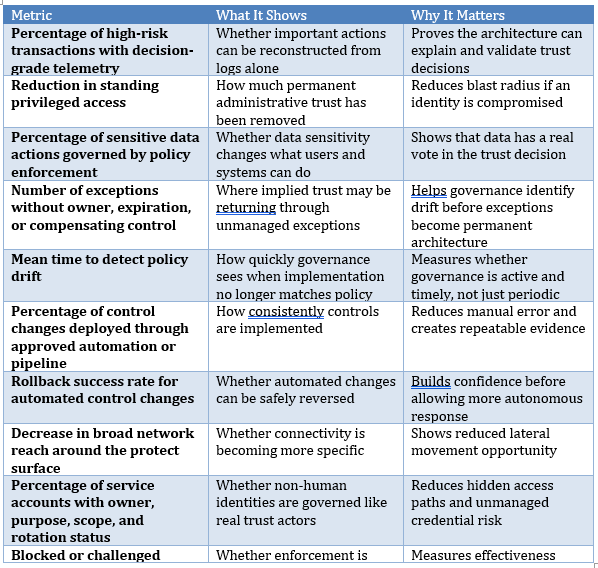
Additional infrastructure and supply chain metrics to consider: percentage of production workloads built from approved image factories or golden images; percentage of infrastructure changes deployed through infrastructure-as-code; percentage of releases with an SBOM generated automatically at build time; percentage of SBOMs ingested into vulnerability management; mean time from vulnerable component discovery to risk decision; and number of infrastructure baselines with current telemetry, patching, and rollback evidence.
Notice the difference in those metrics. They are not asking whether teams were busy. They are asking whether the architecture is becoming more trustworthy. Can we prove the decision? Did we reduce standing trust? Did we narrow reach? Did we catch drift? Did automation work safely? Did governance see the problem while it was still small?
What We Are Really Building
At this stage, we are not trying to build a magic security machine that makes every decision without us. We are building a functional operating model for trust. The pillars help make the decision. Visibility and Analytics prove the decision happened. Automation and Orchestration implement the controls consistently. Governance keeps those controls tied to policy, risk, and business intent.
That is enough to change the conversation. Instead of asking whether the organization has “done Zero Trust,” we can ask better questions. Can we explain the trust decision for this transaction? Can we prove it was enforced? Can we deploy the same control the same way next time? Can governance see when policy and implementation drift apart? Can we measure risk reduction instead of activity?
If the answer is yes more often this month than last month, the architecture is moving in the right direction.
Before the Next Cup
Here is your homework before the next cup of coffee: choose one high-value transaction in your protect surface and ask three cross-function questions.
1. Visibility and Analytics: Could we recreate this action using telemetry alone, and would the data prove the trust decision was enforced?
2. Automation and Orchestration: Are the controls around this transaction implemented consistently, preferably through a repeatable and tested process?
3. Governance: Can we see right now whether this transaction complies with policy, and would we know quickly if drift started to appear?
If any of those answers depend on someone remembering what happened, manually checking five systems, or trusting that the exception is still temporary, you have found your next practical improvement.
Call to action: This week, do not try to automate everything or build the perfect dashboard. Pick one transaction, define what decision-grade telemetry should look like, identify one control that should move from hands-on implementation to a repeatable process, and choose one governance metric that shows risk reduction instead of activity. Then pick one infrastructure build path and ask whether it starts from a known image, approved configuration, tested rollback plan, and automatically generated SBOM. That is how a functional Zero Trust Architecture starts becoming real.
If you want to dig deeper into these cross-functional capabilities, I cover them in more detail in ZT Foundations: Building Zero Trust with the Tools You Already Have. The book walks through how Visibility and Analytics, Automation and Orchestration, and Governance fit into a practical Zero Trust effort built from the tools and capabilities many organizations already have.
And on a personal note, I also write on civic topics. I am currently looking for ARC reviewers for my new Finding Truths book, A Student of Trust. If you would like to sign up to be a reviewer, you can do that at cletustaylor.com.
As always, I would love to hear your thoughts, questions, pushback, and ideas. Send them to hello@cletustaylor.com, share this post with someone trying to make Zero Trust practical instead of theoretical, and come back next time. I’ll have the coffee ready.


Comments