When Federal Grants Become Political Weapons: Power, Process, and Public Trust
What this week’s court filings reveal about power, process, and the public trust.
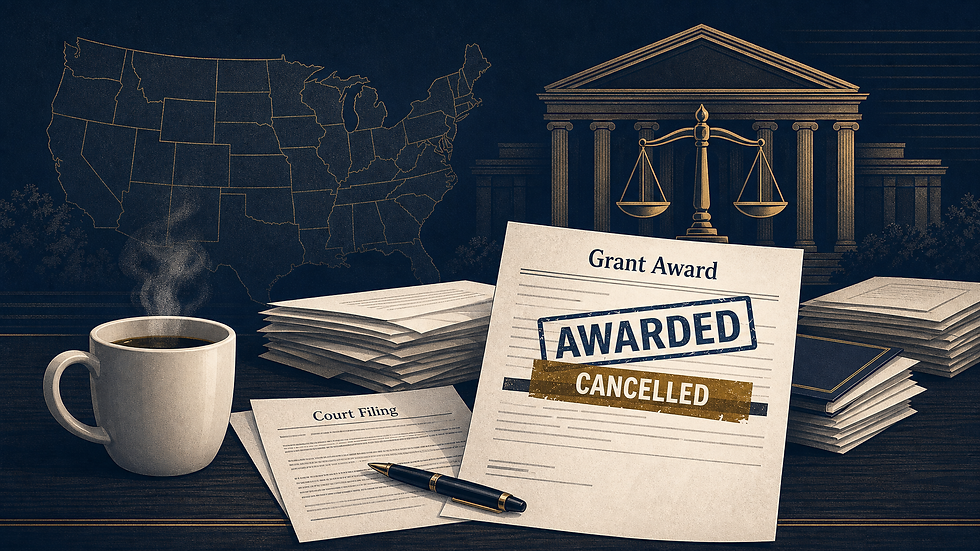
Some stories are loud because people make them loud. Other stories are loud because the paperwork starts talking. Pull up a chair for this one, because the paperwork has apparently had a lot of coffee.
This week’s reporting falls into the second category. Court filings in litigation over federal clean-energy grants include an unusually direct acknowledgment: hundreds of grants were selected for cancellation based on whether the recipient state voted for the Democratic presidential nominee, Kamala Harris, in the 2024 presidential election. The public reporting describes billions of dollars in awards affecting clean-energy, grid, hydrogen, battery, and carbon-capture projects across sixteen states.
That does not require a partisan flamethrower. In fact, this is exactly the kind of story where the better tool is a flashlight. The better question is civic: how are federal grants supposed to work, what happens when political identity becomes the sorting mechanism, and why should ordinary citizens care?
What makes this story important is not merely the dollar amount, though $7.6 billion is not exactly loose change found between the couch cushions or under the car seat next to a fossilized french fry. It is the stated basis for the decision. When the government’s own filings point to political identity as the sorting mechanism, citizens should pause—not to pick a team, but to examine the process.
Start With the System, Not the Shouting
Federal grants are not supposed to be party favors with better letterhead. In the normal process, Congress authorizes and funds programs. Agencies publish rules or funding opportunities. Applicants compete under stated criteria. Agencies review proposals, score them, impose conditions, and then award funds according to law, program purpose, and the record in front of them.
That process can be imperfect. Agencies make mistakes. Programs can be wasteful. Priorities can change after an election. A new president is allowed to set policy direction within the bounds of law. None of that is controversial in a constitutional system.
There is also a difference between changing a future program and clawing back an existing award. A new administration may decide that future grant competitions should emphasize different goals, so long as Congress allows that discretion. But once an agency has awarded funds under existing rules, the government has a stronger obligation to follow the terms, the statute, and the administrative record. That distinction may sound technical, and it will not be the most exciting thing discussed at dinner unless your dinner guests are very patient people. But technical guardrails are often what keep public power from becoming personal power.
The problem begins when the reason for cancellation is not program performance, statutory authority, cost control, or changed eligibility, but political identity. That is where ordinary administration starts looking less like governance and more like retaliation with a routing number.
In this case, reporting from the Associated Press, CNN, NBC News, The Hill, Reuters, and other outlets describes court filings in which federal officials acknowledged that the October 2025 grant cancellations were tied to the political identity of the states involved. That is not a rumor circulating through the political grapevine. It is the kind of documented record citizens should slow down and read carefully.
What the Filings and Rulings Say
First, the clean-energy grant cancellations. Public reporting says the administration acknowledged in court documents that $7.6 billion in clean-energy grants were canceled “based solely on the political identity” of the recipient states. The affected states were described as states that voted for Kamala Harris in 2024, and the grants involved hundreds of projects, including battery plants, hydrogen technology, electric grid upgrades, and carbon-capture efforts.
Second, the broader grant-rule ruling. U.S. District Judge Indira Talwani ruled that federal agencies cannot revoke already awarded grants simply because a new administration later identifies different program goals or agency priorities. The point is not that grants can never be ended. The point is that the rules and conditions matter, and they cannot be rewritten after the award in a way that violates the law.
Coffee Table Rule: If the government changes the rules after the award, the question is not whether you like the project. The question is whether the process still belongs to the law.
Political Priorities Are Not the Same as Political Retaliation
Every administration has priorities. One administration may emphasize clean energy. Another may emphasize fossil fuels, nuclear power, deregulation, industrial policy, or deficit reduction. Elections have consequences, and policy direction is part of democratic accountability.
But there is a line between changing future policy and punishing people for past voting patterns. A president can argue that a future grant program should be redesigned. An agency can decline future awards if applicants do not meet lawful criteria. Congress can change statutes. Courts can review agency action. Those are normal tools of government.
What a constitutional system cannot casually accept is the idea that citizens in one state may lose already awarded federal support because their state voted differently from the president’s preferred political coalition. That is not just a dispute about climate policy. It is a dispute about whether the machinery of government serves the public or disciplines the public.
What We Know, and What We Should Still Watch
Based on public reporting, we know the cancellations were described in court filings as tied to the political identity of recipient states. We know the affected awards involved billions of dollars and hundreds of projects. We know a federal judge has drawn a line around post-award changes to grant conditions.
What citizens should continue watching is just as important: how agencies justify individual cancellations, whether appeals courts narrow or expand the ruling, whether Congress responds, and whether similar logic appears in other funding areas. Finding truth means staying with the record as it develops, not freezing our understanding at the first headline. It also means being willing to update our view if the record becomes clearer, narrower, broader, or more complicated.
Why This Matters Beyond Clean Energy
It is tempting to file this story under energy policy and move on. That would be too narrow. The civic issue is bigger than solar panels, hydrogen hubs, battery plants, or grid modernization. The civic issue is whether federal funding decisions can be converted into political leverage against disfavored communities.
If that principle becomes normal, the target can change with the next administration. Today it may be clean-energy grants in states that voted one way. Tomorrow it could be disaster relief, transportation funding, university research, public safety grants, rural broadband, school nutrition, or cybersecurity support in places that voted another way.
That is how a neutral administrative system becomes a loyalty program, except the points are tax dollars and the customer service desk is located somewhere behind three layers of federal litigation. Not ideal. Also hard to fit on a punch card.
The Ordinary People Problem
Political retaliation through funding does not land on an abstract map. It lands on workers, local governments, universities, contractors, communities, and families who may have very different political views from one another. A state is not a person. A grant recipient is not every voter. A project site is not a ballot box.
When federal funding is awarded, people make plans around it. They hire staff. They sign contracts. They schedule construction. They arrange matching funds. They tell communities that a project is coming. If the award disappears for reasons unrelated to the project’s merits or lawful conditions, the damage is not theoretical. It can mean delayed jobs, stranded local budgets, canceled contracts, and communities left explaining why a promise from one part of government vanished through another.
The citizens affected may include people who voted for the president, people who voted against him, people who did not vote, and people too young to vote at all. That is why a civic analysis has to look past team jerseys. Government power rarely lands neatly on the people we imagined when we were cheering for it.
A republic depends on citizens believing that basic public administration is not merely a reward system for political loyalty. Once that trust erodes, every grant announcement, disaster declaration, procurement decision, and enforcement choice starts to look like payback. That is a corrosive way to govern, and an exhausting way to live.
Historical Echoes Without Easy Equivalence
The comparison is not exact, and it should not be forced. But history shows that federal funding often becomes one of the places where arguments over citizenship, loyalty, race, region, and political power are fought indirectly.
· Reconstruction reminds us that federal power can be used to protect rights, but also that backlash often tries to redirect public authority toward partisan or regional punishment.
· The New Deal reminds us that federal spending can reshape local economies, which makes the integrity of allocation rules especially important.
· Urban aid battles in the twentieth century remind us that funding fights often become arguments about who counts, who is blamed, and who gets left waiting for the check.
The lesson is not that every funding dispute repeats the past. The lesson is that funding power is never merely administrative when it determines which communities can build, repair, recover, or plan for the future.
How to Read Federal Funding News Without Spilling Your Coffee
Federal funding stories can become foggy fast because they combine law, budget rules, agency discretion, politics, local impacts, and a vocabulary that seems designed to make normal people reach for a second cup of coffee and maybe a cinnamon roll for emotional support. But readers can still ask clear questions.
Look for statutory authority. What law created the program? What did Congress authorize? What limits did Congress place on the agency? A president cannot spend or cancel money as if Congress were merely a suggestion box with marble columns.
Check the timing of the conditions. Were the relevant goals and requirements stated before the award, or were they introduced later? This is one of the key distinctions in Judge Talwani’s ruling. Conditions known before an award are one thing. Post-award goalpost relocation is another.
Policy Judgment or Identity Test?
· Policy-based justification: the project no longer satisfies lawful program criteria, documented performance standards, budget requirements, or statutory limits.
· Identity-based justification: the project is selected because of the political identity of the state, community, institution, or people associated with it.
· Process-based question: did the agency apply the same standards to similar grants, regardless of political geography?
· Evidence-based question: what does the record say, and does the public explanation match the court filing?
Once readers can separate policy judgment from identity-based punishment, the larger danger becomes easier to see. The issue is not that every canceled grant is unlawful or every changed priority is corrupt. The issue is whether public power starts behaving like a reward-and-punishment machine.
The Civic Danger: Government as a Reward-and-Punishment Machine
· It undermines trust in neutral administration when citizens believe funding depends on political loyalty.
· It destabilizes long-term projects that require years of planning, hiring, contracting, and local coordination.
· It punishes people collectively for electoral outcomes they may not personally support or control.
· It invites escalation because the next administration may decide to use the same weapon in the opposite direction.
The Bigger Lesson: Process Is Part of Truth
Finding truth is not only about identifying whether a claim is true or false. Sometimes it is about understanding whether the process that produced a government decision can be trusted. A technically accurate announcement can still hide the most important question: why were these projects selected?
That is why court filings matter. They slow the argument down. They put claims into a record. They force public officials to describe what happened in language that can be tested. They are not perfect instruments of truth, and they are rarely beach reading unless you are making unusual vacation choices. But they are better than vibes, slogans, and that one uncle’s Facebook post written entirely in capital letters.
The public does not have to agree on every energy policy question to agree on this: federal power should not be converted into a partisan punishment system. If a grant is wasteful, prove it. If a project violates the law, document it. If Congress wants to change the program, legislate it. But if the deciding factor is how a state voted, the issue is no longer just policy. It is public trust.
At the constitutional level, the concern is not simply bad manners in budgeting. It touches basic principles of equal treatment, lawful administration, separation of powers, and protection against arbitrary government action. Those principles are not decorative phrases from a civics textbook. They are the guardrails that keep public authority from becoming private leverage.
Closing: Finding Truth When Power Tests the Process
Here is my challenge for the week, offered with coffee in hand and a respectful nod to everyone who has ever opened a government document and immediately wanted a snack: the next time you read about a federal grant, funding freeze, or agency cancellation, do not stop at whether you like the policy area. Ask what law authorized the money. Ask what conditions existed before the award. Ask whether similar projects were treated similarly. Ask whether the official explanation matches the record. The goal is not to become a budget lawyer overnight. The goal is to become the kind of citizen who knows which questions keep power honest.
A healthy republic cannot run on loyalty tests disguised as administration. It needs lawful process, honest records, and citizens patient enough to read beyond the headline. That may not be as exciting as outrage, but it is sturdier. And sturdy matters when public trust is carrying weight.
Join the Conversation, and Help Launch A Student of Truth
I am also looking for ARC reviewers for my new Finding Truth book, A Student of Truth. If you enjoy careful civic analysis, evidence-based conversation, and the occasional coffee-fueled attempt to make public systems easier to understand without requiring a decoder ring, I would be grateful for your help. You can sign up to be a reviewer at cletustaylor.com.
As always, I would love to hear your thoughts, questions, pushback, and real-world examples. Where have you seen public funding handled well, handled poorly, or used in ways that made people question the fairness of the process? If we were sitting across the table with coffee, what example would you bring to this conversation? What safeguards do you think matter most when federal dollars move from law to agency decision to local project? Send your comments and ideas to hello@cletustaylor.com, or leave a comment wherever you are reading this. Dialogue makes this work better.
A Quick Note About Substack
I have decided not to pursue the Substack at this time. I still like the idea of a deeper weekly analysis space, but right now the Finding Truth table is already covered with notebooks, coffee mugs, research folders, and at least one suspiciously ambitious to-do list.
I am still busy with the rest of my Finding Truth, Secure by Habit, and Zero Trust projects. That includes the initial research and beginning drafts for the next two Finding Truth books, the next two Zero Trust books, and exploring the possibility of turning the Finding Truth series into audiobooks. I do not sleep much, but I do, in fact, require at least one nap a year. I am trying to be medically responsible about it.
Source note: This post refers to July 2026 reporting from the Associated Press, CNN, NBC News, The Hill, Reuters, Politico, and related outlets on court filings concerning the cancellation of clean-energy grants, including reports that $7.6 billion in grants were canceled based on the political identity of recipient states, that the Office of Management and Budget terminated 284 grants in October 2025, and that U.S. District Judge Indira Talwani ruled agencies may not revoke already awarded grants based on post-award program goals or agency priorities. Readers should review the underlying filings and rulings where available, because those primary records matter more than any single headline.
Author note: Cletus Taylor writes the Finding Truth series to encourage thoughtful citizenship, moral courage, and the lifelong work of seeking truth with humility.
Cletus Taylor, keeping the coffee hot for next week’s conversation.


Comments